
21/11/2025
Openbox vs. labwc
I didn't plan on testing it myself since dediomedo already covered it extensively . Only after testing Gentoo's KDE Plasma image and witnessing big CPU spikes when doing nothing but moving the cursor around, I wanted to see it for myself how Wayland's philosophy contributes to the embarrassing state of the entire Wayland ecosystem.
And the best way to demonstrate this failure is on an old space radiator of the following type:
It gets hot fast, its battery doesn't last a whole hour anymore and most of its stickers are faded. It already struggled with the pre-installed Windows 7 back when I first used it and the only distribution mitigating most of its issues is Arch Linux with a stacking window manager and no full-fledged DE. Since I usually rely on Fluxbox, which likely will never see a Wayland equivalent, I started my old Openbox configuration I haven't used in a long time just to get a sense of what I have to look out for when testing labwc.
Openbox
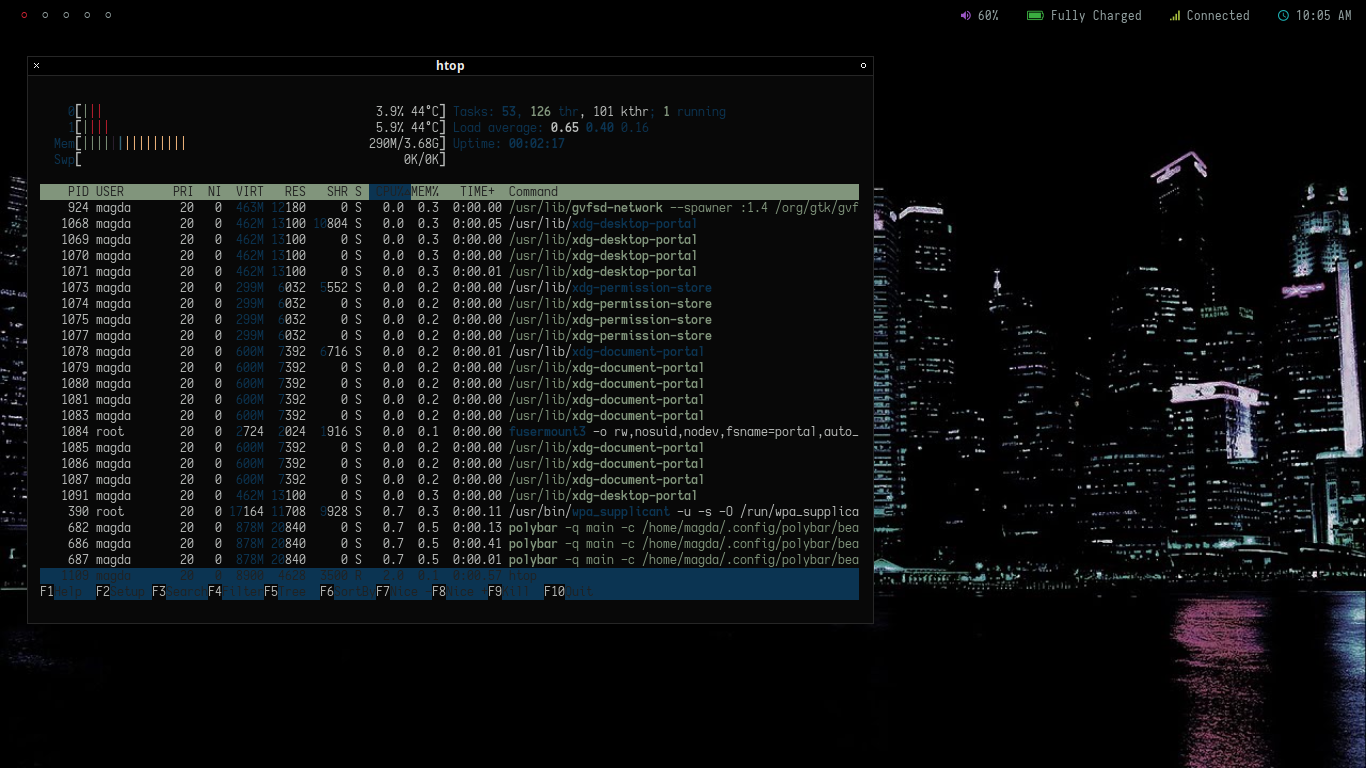
Plain and simple, this Openbox configuration's largely based on a config provided by Archcraft and I couldn't be bothered to remove it after permanently switching to the even-lighter Fluxbox and "uncrafting" it to get a "vanilla Arch". Besides some minor tweaks, I disabled compositing due to causing some overhead and this device not being used to watch videos or play games. It still is a good fallback in case I mess my Fluxbox config up (which still has yet to happen) because it just works.
labwc
labwc is a Wayland compositor attempting to bring the Openbox experience to the Wayland ecosystem.
Not only is labwc still so young that no
distribution includes it among their default
desktops, it's not fully compatible with my
Openbox config despite claiming to work with
Openbox. It complained about incompatible
keybindings and variables such as
SendToNextDesktop
which labwc states to support but practically ends
up only working partially and causing a huge amount
of log spam.
Because of its inclusion of XWayland I assumed that I would not face any more incompatibilities – I couldn't have been more wrong about this. Leafpad refused to start at random times, the right-click context menu's highlights within all X programs were reversed and didn't react most of the time, and the font was nearly unreadable, selecting text never covered the entire section, the clipboard mostly remained inaccessible outside of CTRL + C.
But the worst part was I could not document any of this because scrot doesn't work on XWayland. I had to install grim and, after getting overwhelmed by its even uglier syntax, gave up after learning that it only can take screenshots of the entire screen; just capturing the currently active window or just a specific section of the desktop requires an additional tool.
And just like scrot, Polybar also turned out to require a replacement. While its default configuration was alright, I had to create its config folder manually. I tried searching for community themes and only found themes for Hyprland configs that aren't fully compatible with other compositors (and mostly just typical r/unixporn eye candy I personally consider childish and ugly).
The really ugly
For some tasks I required root access. Naturally I do not switch to my root user whenever I need to do something minor like checking a particular log – X.org lets me do this via sudo and pkexec, though the latter requires writing custom rules. Once set I forget about it and it works reliably.
Wayland's philosophy
is even more aggressive than Windows Vista's
User Account Control
which frustrated a significant amount of users back
in the late 00's: while UAC demanded
authentication for every silly program under the
sun, Wayland compositors
outright refuse to do any admin tasks on a
regular user and, in the case of GUI tools, even
on root
! When I first tried to open Alacritty with elevated
privileges, polkit-xfce didn't even start and
sudo was blocked entirely, even though my user has
been in the right groups since I installed
Archcraft. The only missing thing was
seat
in
/etc/group
. Adding it and including my user resulted in...
nothing.
Gentoo and some other sources advise to run xhost,
which labwc doesn't mention at all, doesn't
exactly work either.
xhost +SI
or any variant thereof doesn't do anything
whereas
xhost +
temporarily lets me use sudo and pkexec. Trying to
include either command in
autostart
or in a seperate script to execute during start...
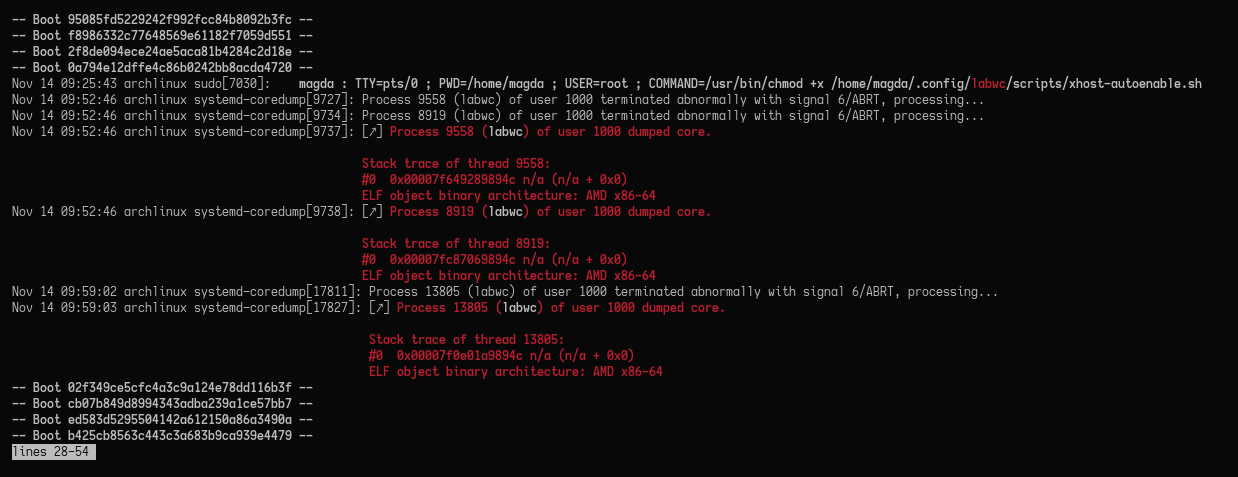
And this happened AFTER realizing that I cannot use
systemctl poweroff
and any other systemctl command anymore across my
entire machine AGAIN. I really don't know how
this happened after this issue first popped up when
I switched to Lemurs (a TUI display manager) and
fixed it the first time this occurred. I sorted this
out a second time but still had to deal with Lemurs
refusing to start labwc after logging out of a labwc
session. I had to start it manually for the 8th
time.
And then I ended up making the dumbest mistake a
user could make. I did a system upgrade on labwc and
broke both my locale settings and
systemd-sysusers.service
. After wasting even more time to get this new issue
fixed, I started labwc one last time just to grab
some data.
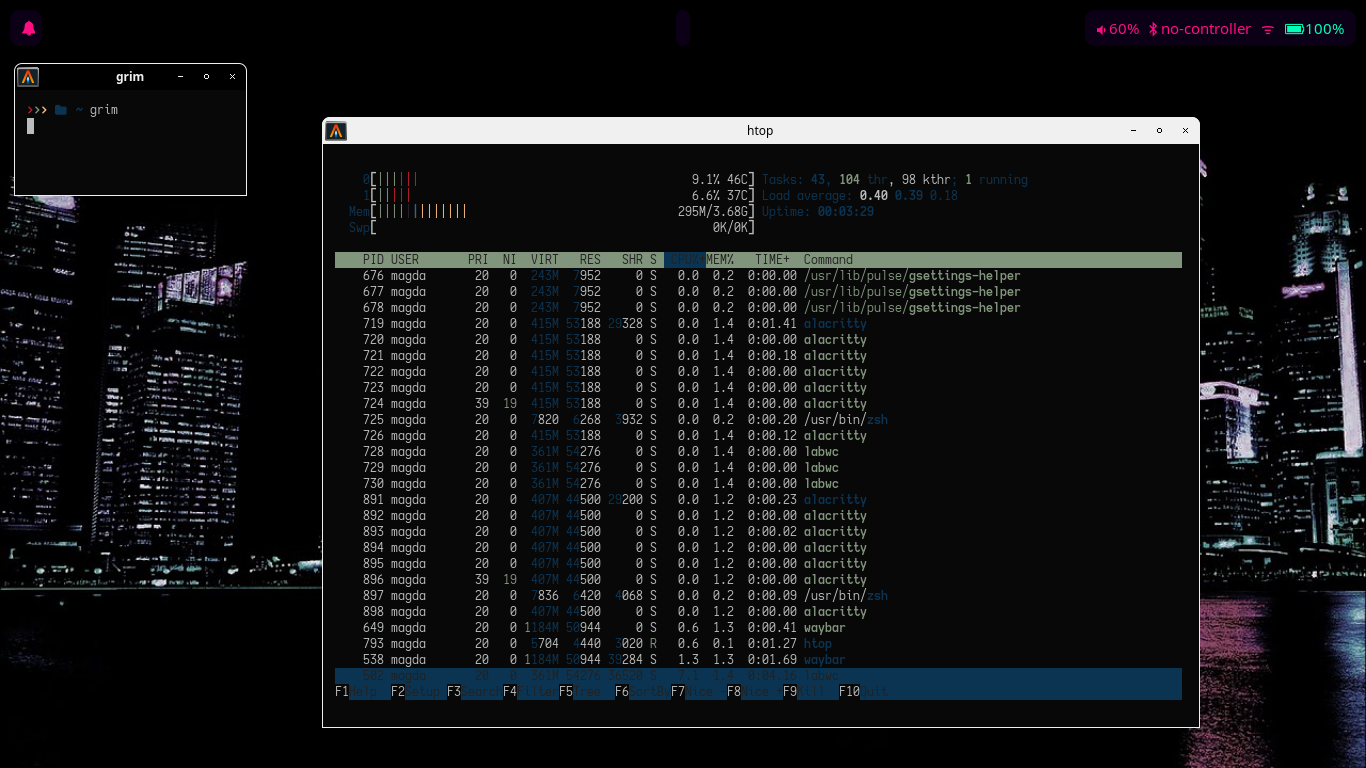
While RAM usage was just slightly lower compared to Openbox, labwc saw similar CPU spikes dedoimedo recored when he tested KDE Plasma's and GNOME's Wayland implementations. After a while my ancient Acer Aspire ran at 50°C under labwc, up to two degrees hotter than under both Openbox and Fluxbox... running at the same time. Waybar also partially broke in the meantime and no longer loaded its clock and calendar.
Out of frustration, I instantly wiped anything Wayland off this machine after I took this screenshot and moved back to my reliable Fluxbox config.
You can't be serious about this
Most critics already covered the essentials , plus forced compositing, unfounded security claims – or rather the lack of actual cases where X.org has been exploited by malware; Wayland devs exclusively rely on theoretical Proof of Concepts – and even the now-proved active sabotage of X.org by Wayland developers (which resulted in X.org's "TearFree" feature being withheld for years and contributed to the birth of the Xlibre fork that implemented it straight away). But there's one question I personally haven't seen anyone asking:
Who is this supposed to target?
Many gamers won't use it because Wayland actively refuses to ensure proper NVIDIA support (and put the entire blame on NVIDIA) and plenty of heavy games run like ass due to increased latency and Linux having been hated by anti-cheat developers way before the even more restrictive Wayland arrived (probably also putting the blame on Steam and affected games alone). It's so bad that a bunch of Steam Deck users go out of their way to install Windows on their consoles – while still being a minority among Steam Deck users, Windows users still make up the vast majority of PC gamers.
Business users largely can't use it because their tools and workflows aren't supported, especially clipboards and drag-and-drop STILL don't work reliably across all Wayland compositors.
Normal users? Screenshots STILL don't work reliably, plenty of programs written for X do not work (or only run with noticeable hiccups) under XWayland. Blurry fonts and messed-up desktop theming don't help either. Wayland devs respond to this by claiming that " Wayland breaks bad software " (the original article has been deleted but the the flagged submission and the discussion still are available on Hacker News).
Disabled users? Let's not get into this .
Anyone can repeat those valid grievances without any of those Wayland devs truly listening. Most of them will tell you to just wait until someone comes around to implement desired features or workarounds which is... already a big red flag because it assumes that there are enough developers willing to do the work (a la "good things will automatically come to you" just world nonsense). Many of them sadly are outright immature and far more obsessed with appearing like some revolutionary tech bro that will solve humanity's biggest technical issues by providing:
...
Uh, HiDPI support, tear-free rendering at the expense of multiplied CPU cycles and... largely locking users out from their own systems because, uh, end users and how they do normal computer stuff are dumb? That's the impression I'm getting from anything Wayland and its similarily minded cousins: GNOME, Flatpak and those desperately trying to push "immutable operating systems" – one Wayland developer contributes to all of those at the same time:
You just can tell that the most vocal Wayland defenders not only believe in a heavily unrealistic way of how computers should work and be used on a fundamental level but they also love to listen to themselves and will simply gaslight anyone even slightly critical of their work. "Oh, you don't like Wayland? Then go back to X11/X.org but remember that WE KILLED IT and you WILL end up with Wayland regardless because IT'S THE FUTURE."
Remember who shoves poor software down everyone's throats? Windows (Android and whatever Apple calls their operating systems nowadays aren't any different but let's stick to the biggest offender). Personally I didn't migrate to Linux to be confronted with the exact same poor choices that ended up driving me away from Windows (...at least partially; I only dual-boot Windows 10 for Lightroom 5.6, which WINE doesn't support in practice and crashes instantly, and Steam, where Proton fails to run games such as DELTARUNE on my Arch Linux installs on my other machines). The only difference between Windows and Wayland is that Microsoft doesn't throw petty tantrums about users switching to its competitors or sticking to older versions (ignoring the fact that Microsoft DID aggressively nag users to upgrade from Windows 7 to 8 until they were forced to tone it down).
As long as Wayland developers – and their ridiculous focus on semantics and cheap ad hominem attacks to deflect any kind of blame, warranted or not – refuse to acknowledge that their entire philosophy is more user hostile than X.org's risky code cruft, Wayland will remain a solution for Wayland devs only, not the average human.
Update (03/12/2025)
: Since I install updates at the end of each month,
I do this under the assumption that this would
mitigate at least some regressions like those I
sometimes encounter after updating systemd and/or
GRUB. This is the first time I witnessed X.org being
responsible for no graphical environment loading,
despite every necessary process running in the
background. I first ignored it because a simple
reboot fixed the initial I/O errors, so I simply
thought that it's just my old Acer just showing its
age. Three days after my recent system upgrade
(today) and X.Org does nothing but kill itself while
the Arch Linux Forum lists similar issues that,
unlike my case, were caused by LLVM, which my system
doesn't depend on. Downgrading
xorg-server
and
xorg-server-common
fixed my issue, making it the first time since I
switched to Linux back in 2020 that I'd encounter a
broken X.org.
I don't know why this happened three days into the new X.org version and just a few months after the remaining X.org maintainers kicked out Enrico Weigelt for introducting bugs. It really just adds fuel to the (conspiracy) theory that X.org is being actively sabotaged by X.org maintainers desperately trying to push Wayland. Weigelt's political opinions aside and considering that my bug occurred on de-facto legacy hardware (instead of a brand-new device where X.org issues appear to be more common), this tells much more about the remaining devs behind X.org than Weigelt who now can pride himself with a solid interest of his XLibre fork, now counting more than 500 contributors. For a project that was largely panned by the usual suspects (and a relatively high amount of "throwaway" accounts) on Hacker News, it is slowly becoming obvious that the Wayland ecosystem has alienated a bunch of developers much more than plain users who struggle to adust to the "Wayland way of doing things".
Don't get me wrong, X.org is one hell of an ugly piece of software. But I don't care if a dev who is younger than me (I'm 27 and just started to attend elementary school when X.org saw its first stable release!) is far more interested in pretending to be a X.org veteran, when in fact they were shitting their pants when X.org was conceived, I won't bother with them just as much they visibly won't bother with anything that's just slightly older than them and just want new stuff for the sake of appearing "modern" and "innovative" (or any other buzzword that not even an AI will use to such obsessive degrees. I could go on about it but there's no point in it. I'll give XLibre a try once it leaves the AUR since it's surprisingly popular on there and thus may make it into Arch's official repositories sooner or later.